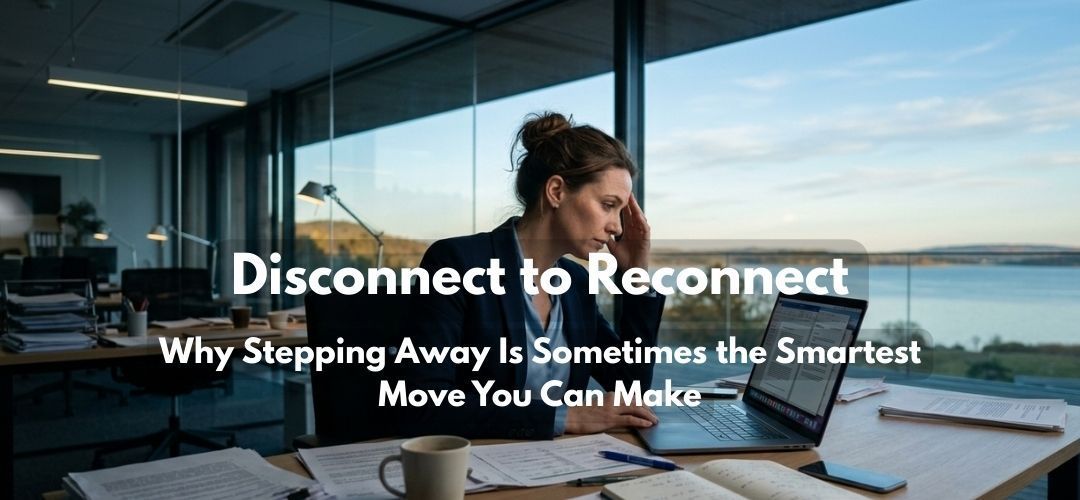
There are seasons when the problem feels too big.
You sit down to work through it… and instead of clarity, you feel stuck.
You become indecisive.
You freeze.
You procrastinate.
Because if you can’t see the full solution, you don’t want to move at all.
Then the pressure builds.
You feel behind.
Rushed.
Short-tempered.
You snap at the people around you — not because they’re the problem, but because your brain won’t turn off.
Sleep gets harder.
Your mind keeps trying to solve it at 2:00 AM.
And the more you sit inside the problem… the heavier it feels.
Here’s what most high-performers do next:
They try harder.
They double down.
Push longer.
Force the solution.
But what if the smartest move isn’t pushing through?
What if it’s stepping away?
Not to hide.
Not to avoid.
Not to quit.
But to reset your perspective — literally.
You Can’t Solve a Problem from the Same State That Created It
Einstein famously said:
“We cannot solve our problems with the same thinking we used when we created them.”
And neuroscience backs this up.
When you’re overwhelmed, your brain shifts into threat mode.
The
amygdala — your brain’s alarm system — activates.
Cortisol increases.
Your thinking narrows.
Instead of creative problem-solving, you get:
• Black-and-white thinking
• Over-control
• Urgency
• Tunnel vision
This is why you become indecisive.
Your brain isn’t broken.
It’s overloaded.
The
prefrontal cortex — the part responsible for strategy, planning, and executive decisions — works best when the nervous system is regulated.
When you stay inside the stress loop, your thinking becomes rigid.
This is called
cognitive fixation.
You keep circling the same thoughts.
The same angles.
The same conclusions.
No new insight can enter because you’re not in a flexible cognitive state.
That’s where disconnecting becomes strategic — not indulgent.
Why Intentional Disconnection Works
Here’s what’s happening when you step away — even if you don’t consciously feel it.
There’s a system in your brain called the
Default Mode Network (DMN). It activates when you’re not actively forcing a solution.
This network is responsible for:
• Insight
• Big-picture thinking
• Memory integration
• Creative connections
It’s why ideas hit in the shower.
Or mid-walk.
Or while driving.
When you intentionally shift your environment or your focus, stress hormones decrease and cognitive flexibility increases.
Your brain stops gripping the problem.
And something powerful happens.
You don’t even notice at first.
You just realize…
“I haven’t thought about it.”
Or when the thought returns, it feels different.
Less urgent.
Less threatening.
Less heavy.
That’s not avoidance.
That’s regulation.
And regulation restores access to
executive function — the part of your brain responsible for strategy, decision-making, and perspective.
This Isn’t Escaping. It’s Recalibrating
There’s a misconception that stepping away means you’re weak. Or distracted. Or avoiding responsibility.
For leaders especially, this belief runs deep.
“If I step away, everything will fall apart.”
“I don’t have time to disconnect.”
“I should be able to power through.”
But powering through from a dysregulated state creates reactive decisions.
Over-control.
Over-communication.
Over-functioning.
And often — poor judgment.
The most strategic leaders I’ve worked with understand something different:
Clarity doesn’t come from force.
It comes from perspective.
Sometimes changing your
literal view changes your mental one.
Looking up instead of down.
Moving your body.
Changing rooms.
Putting the phone away.
Stepping outside your environment.
You shift from
threat mode to
thinking mode.
And thinking mode is where solutions live.
What Changes When You Reconnect
For me, the first shift isn’t the solution.
It’s calm.
That feeling of being on edge starts to fade. The urgency softens. My nervous system settles down enough that my brain can think clearly again.
And once that calm returns, something else follows right behind it: clarity.
Not necessarily the full answer.
Just the
next step.
Too often we put pressure on ourselves to solve the entire problem at once. We sit in the tension trying to force the solution, believing that if we just think about it long enough, we’ll eventually figure it all out.
But that pressure is exactly what keeps us stuck.
When I intentionally disconnect, the focus changes. Instead of asking, “What’s the solution?” I start asking a better question:
“What’s the next step?”
And that one shift releases an incredible amount of pressure.
Because progress doesn’t come from solving everything at once.
It comes from taking the next right step.
Then the next.
Then the next.
Disconnecting Isn’t Avoidance. It’s Strategy
The most successful leaders, entrepreneurs, and individuals I’ve worked with eventually learn this lesson:
You cannot force clarity from a dysregulated mind.
Sometimes the most productive thing you can do is step away long enough to change your perspective.
To reset your nervous system.
To allow your brain to reconnect with the parts responsible for creativity, strategy, and insight.
Disconnecting isn’t about ignoring the problem.
It’s about creating the conditions where the solution can finally emerge.
And often, when you return, the problem isn’t as overwhelming as it felt before.
You’re calmer.
More patient.
More focused.
And ready to move forward — one step at a time.
A Final Thought
If you’re feeling stuck right now…
If the problem feels bigger the longer you stare at it…
Try something different.
Step away.
Change your environment.
Move your body.
Put the phone down.
Give your mind space to breathe.
You might be surprised by what becomes clear once you reconnect with yourself.
And if you’re struggling to find that clarity on your own, sometimes an outside perspective can help you see what you’ve been too close to recognize.
That’s exactly what a
Clarity Session is designed to do.