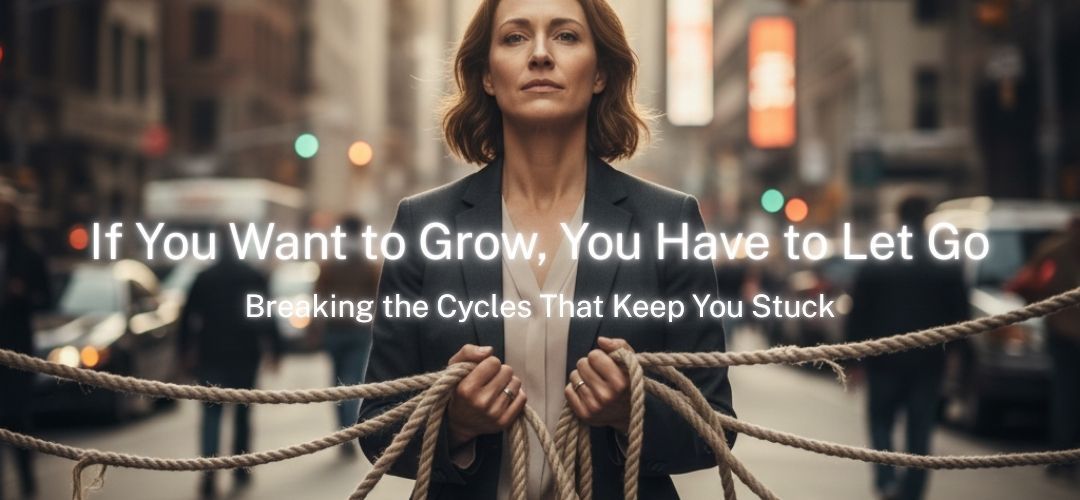
There is a particular kind of exhaustion that doesn’t come from working too hard.
It comes from repeating the same pattern… over and over again… and wondering why nothing changes.
You keep doing the “right” things.
You show up.
You work hard.
You take responsibility.
You give people the benefit of the doubt.
You try to make life easier for everyone around you.
And yet… you’re frustrated.
Resentful.
Exhausted.
At some point you have to ask:
Why does this keep happening?
The Cycle I Didn’t See
For most of my life, I believed something very simple:
If I take on more responsibility…
If I make life easier for everyone else…
If I work harder than anyone in the room…
Then I will be appreciated. Loved. Respected.
In my career, I thought the more I took on, the better leader I would be.
In my relationships, I thought the more I carried, the more secure they would become.
In my home, I thought if I handled everything, everyone would feel supported.
Instead, I ended up resentful.
I didn’t understand why no one stepped in.
Why no one offered help.
Why I felt alone in rooms full of people.
What I couldn’t see at the time was this:
I had trained everyone around me that I didn’t need help.
I ran my village off.
Not because they didn’t care.
But because I never made space for them to show up.
The Breaking Point
The cycle finally broke when I did.
There was a moment where I hit the ground in tears because I felt like I was failing at everything.
At work, I was buried in day-to-day operations and couldn’t focus on growth.
At home, I was too overwhelmed to be present.
Short-tempered. Distracted. Guilt-ridden.
In my relationship, I felt like everything was my responsibility — and somehow also my fault.
I believed asking for help made me weak.
But I secretly expected people to see my silent exhaustion and step in anyway.
That contradiction is where burnout lives.
And that’s when I realized:
The problem wasn’t effort.
The problem was the pattern.
Why We Repeat Cycles
This isn’t random.
Psychologically, many high-functioning adults develop what’s often referred to as over-functioning dynamics.
We learned — consciously or unconsciously — that love, safety, or validation came from:
- Being capable
- Being needed
- Being productive
- Being “the strong one”
So we double down on those behaviors.
Entrepreneurs hustle relentlessly to build something from nothing.
Employees overperform to earn promotions.
Parents overextend to prove devotion.
But here’s what we forget:
What got you here won’t take you there.
The hustle that built your career can destroy your peace.
The independence that protected you can isolate you.
The productivity that earned praise can evolve into resentment.
We don’t update our operating system as our life changes.
When you’re single, one rhythm works.
When you get married, it needs to adjust.
When you have children, it must evolve.
When you step into leadership, your behavior has to change again.
Growth requires evolution.
And evolution requires letting go.
The Professional Version of This Cycle
I see this constantly in founders and executives.
Early in your career, you hustle to prove your worth.
You work 60–80 hours.
You say yes to everything.
You outwork everyone in the room.
It works.
You get promoted.
You build the business.
You grow the revenue.
But then you stay in that same operating pattern.
You keep hustling the same way.
You keep taking on the work.
You keep solving every problem yourself.
And suddenly you’re the bottleneck.
The very behaviors that created growth are now suffocating it.
You’re exhausted.
Your team feels disempowered.
Innovation stalls.
Not because you aren’t capable.
But because you never shifted the pattern.
Letting Go Is Not Passive
Here’s the part people misunderstand:
Letting go isn’t about doing less.
It’s about doing differently.
It’s about consciously deciding:
- This behavior served me once — but it doesn’t serve me now.
- This identity protected me — but it’s limiting me.
- This pace built momentum — but it’s no longer sustainable.
In business, letting go might mean:
- Redefining your role so you stop operating as the doer.
- Rewriting job descriptions to build accountability.
- Implementing structure instead of relying on heroic effort.
- Delegating before you feel fully ready.
In life, letting go might mean:
- Asking for help without shame.
- Communicating needs clearly instead of hoping they’re noticed.
- Allowing someone else to carry weight.
- Releasing the belief that your value is tied to productivity.
This is not soft work.
This is strategic work.
It requires awareness.
It requires honesty.
It requires identity shifts.
And most people don’t break cycles because they try to change behavior without changing belief.
Breaking the Cycle
You don’t break cycles by simply realizing you’re in one.
Awareness is step one.
Strategy is step two.
You have to decide who you are becoming in this next season.
Because if you don’t consciously evolve, you will unconsciously repeat.
The entrepreneurs I coach who feel stuck at a revenue ceiling?
They’re still operating from survival mode.
The executives drowning in the weeds?
Still running the playbook that got them promoted.
The individuals stuck in frustrating relationships?
Still trying to earn love through over-functioning.
Letting go isn’t about abandonment.
It’s about alignment.
It’s about building systems, boundaries, communication, and identity that match the level you’re stepping into.
And that doesn’t happen by accident.
It happens when you’re willing to examine the cycle… and choose differently.
If you read this and thought,
“So that’s where I’m going wrong…”
Good.
That’s the beginning.
Because once you can see the pattern, you can stop living inside it.
If you read this and thought,
“So that’s where I’m going wrong…”
Good.
That’s the beginning.
Because once you can see the pattern, you can stop living inside it.
But seeing it and shifting it are two different things.
Letting go of the behaviors that once kept you safe — the over-functioning, the over-performing, the over-carrying — takes intention. It takes strategy. It takes support.
And sometimes, it takes someone outside the cycle to help you see what you can’t.
If you’re tired of repeating the same patterns in your leadership, your relationships, or your life… it might be time for a
clarity session.
Not because you’re broken.
But because you’re ready to grow.
And what got you here won’t take you there.