Something’s not working—but what exactly is it?
You’ve got a team member who used to shine, and now… not so much.
Maybe they’ve been promoted into a bigger role. Or maybe the business grew, and their responsibilities grew with it.
But now expectations are missed. Communication feels off.
You’re frustrated.
They’re frustrated.
And you start asking the question no leader wants to say out loud:
Do I need to let this person go?
But before you make a costly move, here’s the real question to ask:
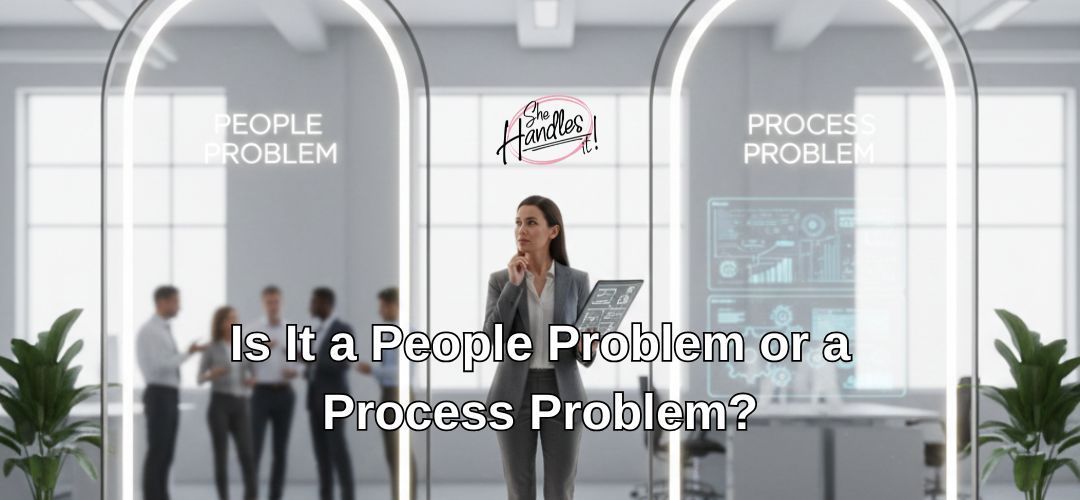
Is it a people problem… or a process problem?
The Hidden Cost of “Missing Structure”
I’ve seen this play out many times in coaching and consulting:
An employee gets promoted—often because they were a rock star in their old role—and suddenly, performance starts slipping.
At first, you might assume they just can’t handle the new responsibility.
But dig a little deeper, and what you’ll often find is this: they were never given clarity on what the new role actually required.
They’re still operating like they’re in their old job.
They’re doing tasks they shouldn’t be doing, managing the way they always have, and feeling overwhelmed by vague expectations and unclear authority.
You’re frustrated that they aren’t stepping up.
They’re frustrated that they don’t know what “stepping up” actually looks like.
Neither of you is winning.
This is what I call
a clarity gap, and it’s one of the biggest drivers of dysfunction on growing teams.
The First Thing I Always Ask
Whenever a leader comes to me about a performance issue, I start with one simple question:
“What job description did they receive?”
You’d be shocked how often the answer is, “We never updated it.”
Or, “We kind of talked about it.”
Or, “Well, they should know.”
If there’s no updated job description, no clear metrics, and no discussion about how success is defined—it’s not a people problem. It’s a leadership one.
That doesn’t make you a bad leader.
It makes you a normal one.
Because most founders and business owners are moving fast.
They promote from within (which is great!) but they forget that role clarity doesn’t happen by osmosis.
How to Actually Diagnose the Problem
If you’re unsure whether you’re dealing with a people or a process problem, here are a few signs:
You’re dealing with a process problem if…
- There’s no clear, written job description for the current role
- Performance expectations were never explicitly discussed
- There are no metrics or scorecards in place to define success
- The employee is doing work outside their scope—either too much or not enough
- Feedback is based on gut feelings, not observable facts
You’re dealing with a people problem if…
- The employee does have clarity, but they’re unwilling or unable to meet expectations
- They resist accountability, even after structure is introduced
- You’ve clearly outlined the role and offered support, but progress still isn’t happening
But here’s the nuance:
Many “people problems” started as clarity problems.
And many performance issues can be fixed before they escalate… if the right conversation happens early.
Rewriting the Playbook (and the Job Description)
If you’ve uncovered that something hasn’t been clearly defined, here’s what to do next:
- Write it down. Update the job description. Outline the responsibilities. Define how success will be measured.
- Have the conversation. Sit down with your team member. Review the expectations. Invite their feedback.
- Ask for buy-in. People don’t commit to what they don’t understand. Help them feel ownership in the role.
- Check for alignment. Are they truly the right fit for this version of the job? Do they want it? Can they grow into it?
And when it’s a broken system—not just a role—take a step back and involve the entire team. Redefine the process. Assign accountability. Get everyone on the same page.
Clarity creates confidence.
And confidence builds momentum.
Don’t Lose a Good Person Over a Fixable Problem
Before you let frustration take the wheel—before you move someone out of a role or out of your company entirely—pause and ask:
- Have I clearly defined this role?
- Have I communicated my expectations?
- Have we both agreed on what success looks like?
You might be surprised how many “people problems” start to disappear when everyone’s on the same page.
And if they don’t? Then at least you’ll know you gave clarity first.
That’s not only fair—it’s good leadership.
If your business is growing and your team isn’t keeping pace, you don’t have to figure it out alone. Sometimes it just takes an outside perspective to help untangle what’s really going on and get you back on track.
Let’s talk.
If you’re ready to build a stronger, more aligned team,
book a free discovery call and let’s figure out what’s really getting in the way—together.