How to Rediscover Yourself When You've Lost Your Identity in Midlife
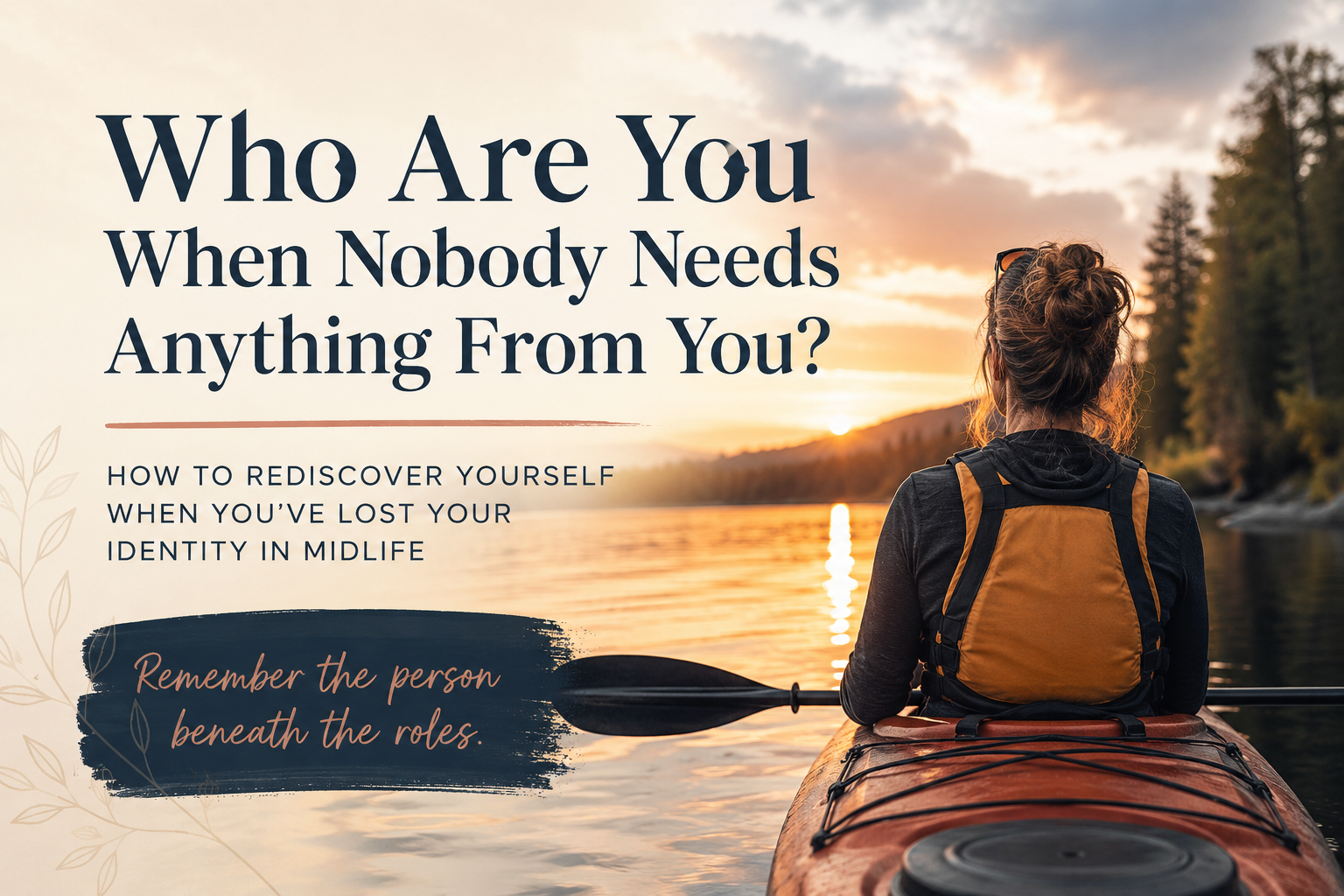
Who are you when nobody needs anything from you?
Not when the kids need a ride.
Not when your spouse needs support.
Not when your team needs answers.
Not when your clients need direction.
Not when the house needs attention.
Just you.
No role to perform.
No responsibility to manage.
No one waiting for you to be something for them.
Who are you then?
For many of us, that question is harder to answer than we want to admit.
We can easily list our roles.
Mother.
Wife.
Husband.
Executive.
Business owner.
Caregiver.
Friend.
Problem solver.
Peacekeeper.
But when you strip all of that away, when you remove the titles, expectations, responsibilities, and identities we collect over time, many people hit a strange and uncomfortable silence.
Because somewhere along the way, we become so committed to the roles we play that we forget the person playing them.
Many people describe this feeling as "losing themselves."
It often happens during major life transitions such as divorce, parenthood, career changes, empty nesting, caregiving, or simply reaching midlife and realizing you've spent so much time meeting everyone else's needs that you've lost touch with your own.
If you've ever thought, "I don't even know who I am anymore," you're not alone.
And you're certainly not broken.
How We Lose Ourselves Without Realizing It
This kind of self-loss usually does not happen all at once.
Most people do not wake up one morning and decide, "I think I'll abandon myself today."
It happens slowly.
One compromise at a time.
One hobby postponed.
One interest dismissed.
One dream delayed.
One need ignored.
At first, it feels responsible.
You adjust because the family needs you.
You shift because the relationship requires it.
You sacrifice because the career is demanding.
You stay quiet because it keeps the peace.
You make yourself smaller because it feels easier than creating conflict.
And to be clear, roles are not bad.
Being a parent can be beautiful.
Being a partner can be meaningful.
Being a leader can be fulfilling.
Being dependable can be a gift.
The problem begins when the role becomes the whole identity.
When you are no longer a person who is a mother, but only Mother.
No longer a person who leads a business, but only CEO.
No longer a person in a relationship, but only Wife or Husband.
No longer a person with dreams, desires, and needs of your own, but the one who exists to make everything easier for everyone else.
And the hardest part?
The world often rewards this.
People call you strong.
Reliable.
Selfless.
Dedicated.
A rock.
Meanwhile, quietly, you may be disappearing.
Signs You've Lost Yourself in Your Roles
One of the most common things I hear from coaching clients is:
"I don't know who I am anymore."
They aren't saying they forgot their name.
They're saying they've lost touch with themselves.
Some common signs include:
- You struggle to answer the question, "What do I want?"
- You don't have hobbies or interests that are just for you.
- Your identity revolves around your responsibilities.
- You feel guilty when you prioritize yourself.
- You spend more time taking care of others than nurturing yourself.
- You feel disconnected from the things that once brought you joy.
- You often feel drained but can't pinpoint why.
These are not signs that you're failing.
They may simply be signs that you've been living from your roles for so long that you've lost connection with the person underneath them.
When the Roles Become Your Identity
I did not realize how much of myself I had lost until I was going through my divorce.
During the separation, we started splitting time with our daughter. Every other weekend, I suddenly had time to myself.
At first, you would think that would feel freeing.
But honestly?
I had no idea what to do.
I had spent so many years being needed that I did not know who I was when no one needed anything from me.
I had become the wife I thought I was supposed to be.
The mother I thought I was supposed to be.
The employee, boss, caregiver, and peacekeeper I thought I was supposed to be.
And somewhere underneath all of those layers, I had lost touch with me.
One of the first things I realized was that I had let go of hobbies that once made me feel alive.
Kayaking.
Hiking.
Being outside.
Moving through nature.
They did not fit the life I was living at the time, so little by little, they disappeared.
Not because I stopped loving them.
Because they stopped making the list.
And when I finally had time to myself, I had to admit something that felt both sad and eye-opening:
I did not really have hobbies of my own anymore.
I had become so identified with the roles I was playing that I had forgotten how to simply be CJ.
The Hidden Cost of Role Engulfment
There is actually a name for this.
In psychology, the concept of
role engulfment describes what happens when a role becomes so dominant that it consumes a person's identity.
We stop seeing ourselves as whole people who hold roles.
Instead, we become the role.
This can happen in motherhood, marriage, leadership, caregiving, entrepreneurship, and even achievement.
It often happens to high-capacity people because we are good at carrying things.
We are good at adapting.
Good at stepping up.
Good at becoming what the moment requires.
But over time, if we are not careful, adaptation turns into disappearance.
The role gets louder.
The person gets quieter.
And eventually, many people find themselves searching for answers to questions like:
- How do I find myself again?
- Why do I feel lost in midlife?
- How do I reconnect with myself?
- Why don't I know what I want anymore?
Those questions are not signs of weakness.
They are invitations to rediscover yourself.
Why This Often Happens in Midlife
There is a reason this tends to surface during midlife.
Midlife is often when the roles we have been playing start to shift.
Children get older.
Marriages change.
Careers evolve.
Parents age.
Bodies change.
Priorities shift.
And suddenly, the life we built around responsibility, performance, and expectation starts asking different questions.
Is this still who I am?
Is this still what I want?
What matters now?
What have I been ignoring?
What have I outgrown?
This is not always a crisis.
Sometimes it is an awakening.
Psychologists have studied how our relationship with time changes as we age. One theory, called
Socioemotional Selectivity Theory, suggests that as people become more aware that time is finite, they become more selective about where they spend their energy.
In simple terms:
At some point, you stop wanting to spend your life performing for approval.
You become less interested in keeping everyone comfortable at the expense of your own truth.
You start caring less about what people think because you finally care more about what you think.
And that shift can be incredibly liberating.
The Joy of Remembering Yourself
When I started getting back on the water and back into the woods, I felt two things.
First, sadness.
Sadness that I had lived so long disconnected from something that made me feel so alive.
Sadness that I had let pieces of myself get tucked away because they did not fit the version of life I was trying to maintain.
But then came joy.
Pure joy.
For the first time in a long time, no one needed anything from me in those moments.
No one was asking me to solve, manage, fix, organize, cook, clean, lead, or perform.
I was just there.
On the water.
In the woods.
Breathing again.
And what started as trying to figure out what to do with myself became something much bigger.
It became regulation.
It became grounding.
It became a way back to myself.
Research consistently shows that activities like spending time in nature, exercising, pursuing hobbies, and engaging in meaningful recreation can improve mood, reduce stress, and support emotional well-being.
In other words, getting back on the water wasn't just about kayaking.
It was about reconnecting with myself.
How to Reconnect With the Person Beneath the Roles
This is something I work on with coaching clients often.
When someone tells me they feel lost, stuck, or disconnected from themselves, I do not start by asking them to reinvent their entire life.
I start much smaller.
I ask them to look at their week.
Write down everything you do in the normal course of your life.
The work tasks.
The household tasks.
The family responsibilities.
The caregiving.
The errands.
The conversations.
The routines.
The obligations.
Then we start categorizing.
What energizes you?
What drains you?
What feels aligned?
What feels like a performance?
What are you doing because you truly want to?
What are you doing because you believe you have to?
And then comes one of the most important questions:
If no one needed anything from you, what would you want to do for yourself?
That question can feel uncomfortable at first.
Some people do not know how to answer it.
But eventually, themes start to emerge.
Forgotten hobbies.
Creative interests.
Places they miss.
Parts of themselves they have not visited in years.
Passions that got buried beneath responsibility.
This is often where people begin finding themselves again.
You Are Allowed to Evolve
One of the greatest gifts of midlife is realizing that you are allowed to change.
You are allowed to want different things now.
You are allowed to admit that what once worked no longer fits.
You are allowed to stop performing a version of yourself that was built around survival, approval, or expectation.
And no, this does not mean you stop caring about the people you love.
It does not mean you abandon your responsibilities.
It does not mean you become selfish.
It means you stop confusing self-abandonment with love.
It means you stop confusing being needed with being valued.
It means you remember that you are allowed to be a whole person, not just a collection of roles.
Final Thought
The goal is not to stop being a mother.
Or a wife.
Or a husband.
Or a leader.
Or a caregiver.
Or the person others can count on.
The goal is to remember that before you were any of those things, you were a person.
A person with interests.
A person with joy.
A person with desires.
A person with intuition.
A person with a life of your own.
And that person still deserves your attention.
Because the healthiest version of you is not the one who disappears into every role they play.
It is the one who remembers who they are beneath them.
So ask yourself:
Who are you when nobody needs anything from you?
And if you do not know the answer yet, that does not mean you are lost.
It simply means it may be time to start listening.
Feeling disconnected from yourself? Unsure what you want next? My Clarity Sessions are designed to help you reconnect with who you are, uncover what truly matters, and create a life that feels aligned with the person beneath the roles.
Schedule one today.